
 July 20, 2026
 9 min read mins read
  0 Comments
 Being a foreign business owner in the U.S. tax regime can be difficult. A foreign-owned LLC is a U.S. company that is owned by individuals or companies outside of the United States. Many owners think that because their company doesn’t produce income in the U.S., they are not responsible to the federal government. However, that is the not the case when it comes to foreign owned llc tax filing.
The IRS maintains a strict policy on reporting in 2026 and penalties are harsh for not following the policy. This guide by OCPbiz provides the information, forms and instructions you will need to ensure your business stays in good standing with the IRS.
When filing a foreign-owned LLC tax return in 2026, the following is crucial to grasp. The following is important to understand when filing in 2026.
A foreign-owned LLC is a Limited Liability Company with at least one foreign (non-U.S.) member or one foreign (non-U.S.) entity as member. It depends on the membership size, but the IRS identifies them as for foreign owned llc tax filing:
The first step towards complying with tax filing of your foreign owned LLC is to know your federal tax status.
Tax liability is not necessarily to be linked to the existence of U.S. profit. If you believe you are required to consider filing, then you should file it even as a non resident llc taxes, if:
Don’t take it for granted that having a zero-income year means there are no llc tax filing requirements.
The required documents for us tax filing services for an LLC owned by foreigners in 2026 include the following:
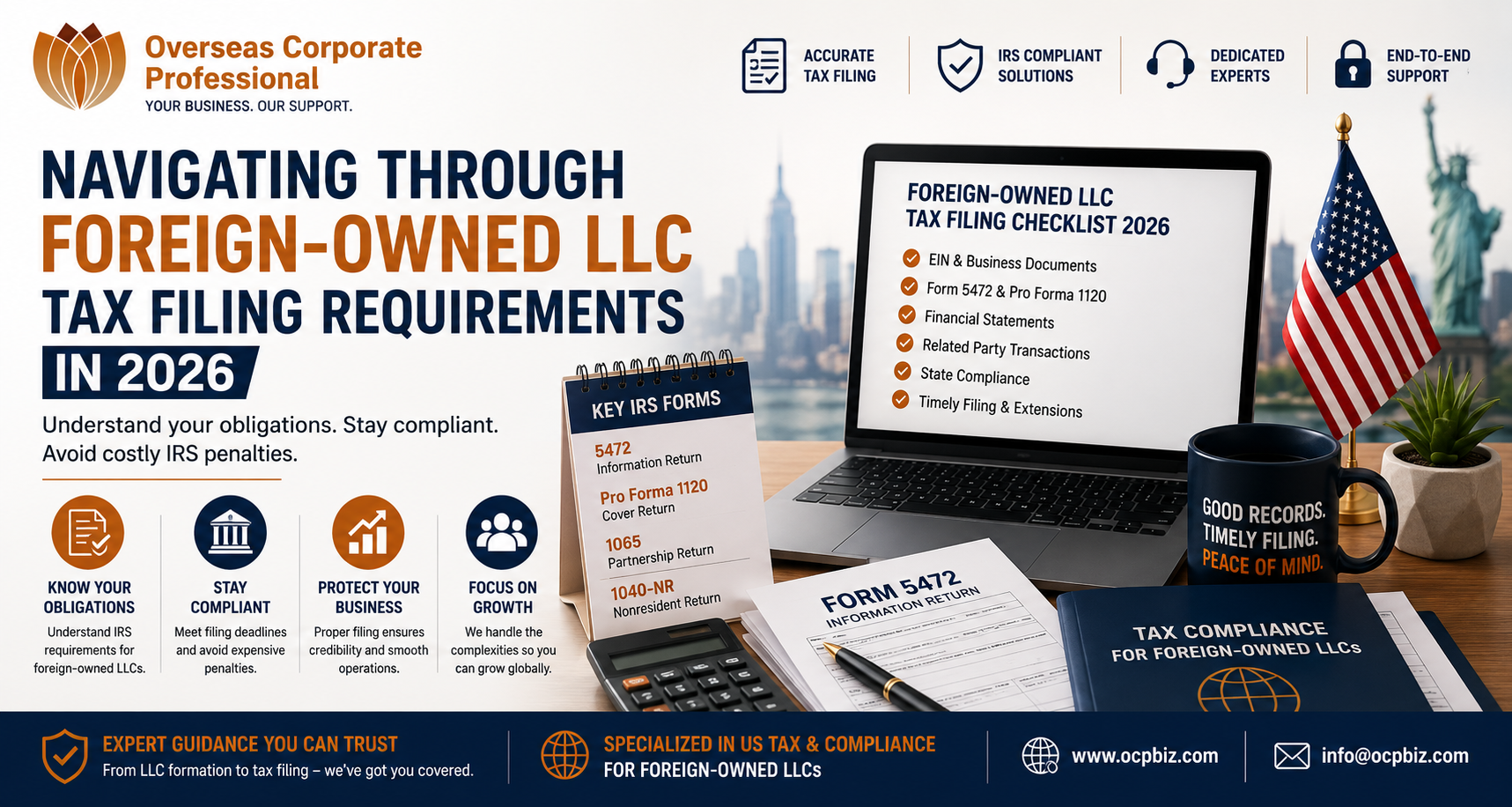
The following is a list of some of the important IRS Forms you might need.
| Form | Purpose | Applicability |
|---|---|---|
| Form 5472 | Information return for U.S. corporations/LLCs that are foreign owned. | Must be supplied for reportable transactions. |
| Pro Forma 1120 | Indicates that Form 5472 is covered by this item. | For single member LLCs, required. |
| Form 1065 | Partnership tax return. | For multi-member LLCs. |
| Form 1040-NR | Individual income tax return (NR – Nonresident). | If the owner has U.S. effectively connected income. |
| Form 7004 | Automatic 6-month extension. | To prevent late filing fines. |
The most important part of the form 5472 filing is that related to transactions between the foreign owner and the LLC. If your LLC is a disregarded entity, you will have to submit Form 5472 to a “pro forma” Form 1120. This is the most frequent reason for IRS penalties that are issued if not done correctly.
Staying on schedule is a must. For most foreign-owned companies, the standard deadlines will be the middle of April. If you need more time, you may file Form 7004 within the time limit to automatically get a six-month extension. IRS systems are very automated and the electronic filing is strongly encouraged to ensure that they are received and processed.
You should definitely know what you are required to file based on your type of entity. Hence, here is an overview of the typical filings required for each type of entity.
| Entity Type | Typical Federal Filing Requirement |
|---|---|
| Single-Member LLC (A member of a limited liability company that operates on its own.) | Form 1040 (Schedule C) |
| Multi-Member LLC (A partnership return in the form of a return to the IRS.) | Form 1065 (Partnership Return) |
| LLC Taxed as C-Corp | Form 1120 |
| C-Corporation | Form 1120 |
| Corporate Tax Return – LLC (Taxed as Corp) | Form 1120 |
The most prevalent myth that foreign founders have is that if they are not in the U.S. then they are not subject to U.S. taxes. This is incorrect. If your business generates ‘Effectively Connected Income’ (ECI), then you will be taxed on that income. Yes, there are provisions of irs filing for llc for that.
If your income is exclusively “Fixed, Determinable, Annual, or Periodical” (FDAP), then it’s a different rule. The safest and easiest way to ascertain your particular ECI status and to avoid over or under-payment is to work with an experienced United States tax specialist.
Late filing penalties: Penalties will be incurred if deadlines are not met.
You can download this Foreign-Owned LLC Tax Filing Checklist.
Compliance is not just a one-time occurrence. It is a responsibility that comes with operating. Below is a 2026 llc compliance requirements agenda:
The price of non-compliance for annual tax filing usa, in terms of monetary penalties and the aggravation of working with the IRS, is too high to risk. From foreign-owned LLC tax issues to advanced tax treaty applications, having someone who knows the intricacies of U. S. tax law can help in your growth.
At OCPbiz, we focus on the foreign business owners and how to guide them through the difficulties of operating a U. S. business. We simplify the LLC tax filing process for you to have more time for growing your business instead of doing paperwork.
To keep your business’s credibility in the U.S. market, it’s crucial to be up to date with your LLC tax filing requirements. Regardless of whether you are filing foreign owned llc tax filing or handling the complicated issues of related party transactions, organization is key to avoiding any IRS penalties.
When in doubt, there is tax expert help available at OCPbiz that can make the process of filing tax documents easier and your filings accurate and timely. You can’t wait until after you’re done with your company to start writing the documentation; write it now!
Wishing you wanted to hire an expert to help you with your tax duties in the United States? Get hold of an expert that you can talk about foreign-owned LLC compliance. Connect with OCPbiz, and we will handle your tax filing needs.
Yes. An LLC must have an Employer Identification Number (EIN). This is the tax identification number of your business, which you will need for filing the taxes of your LLC.
Yes. You are a foreign owned single-member LLC if you are owned by a foreign person and are a single member LLC. Foreign owned single-member LLC, foreign person owner of a single-member LLC is a "Section 6038A reporting corporation. This is the most common cause of IRS penalties for not filing this form.
Filing some forms may be done on your own, but it is a well-known fact that the U.S. tax code is a very complicated piece of legislation. Most of the most successful international founders use a us tax consultant in order to be accurate and make use of any tax treaties between their country of origin and the U.S.

Thank you for your message. It has been sent successfully.