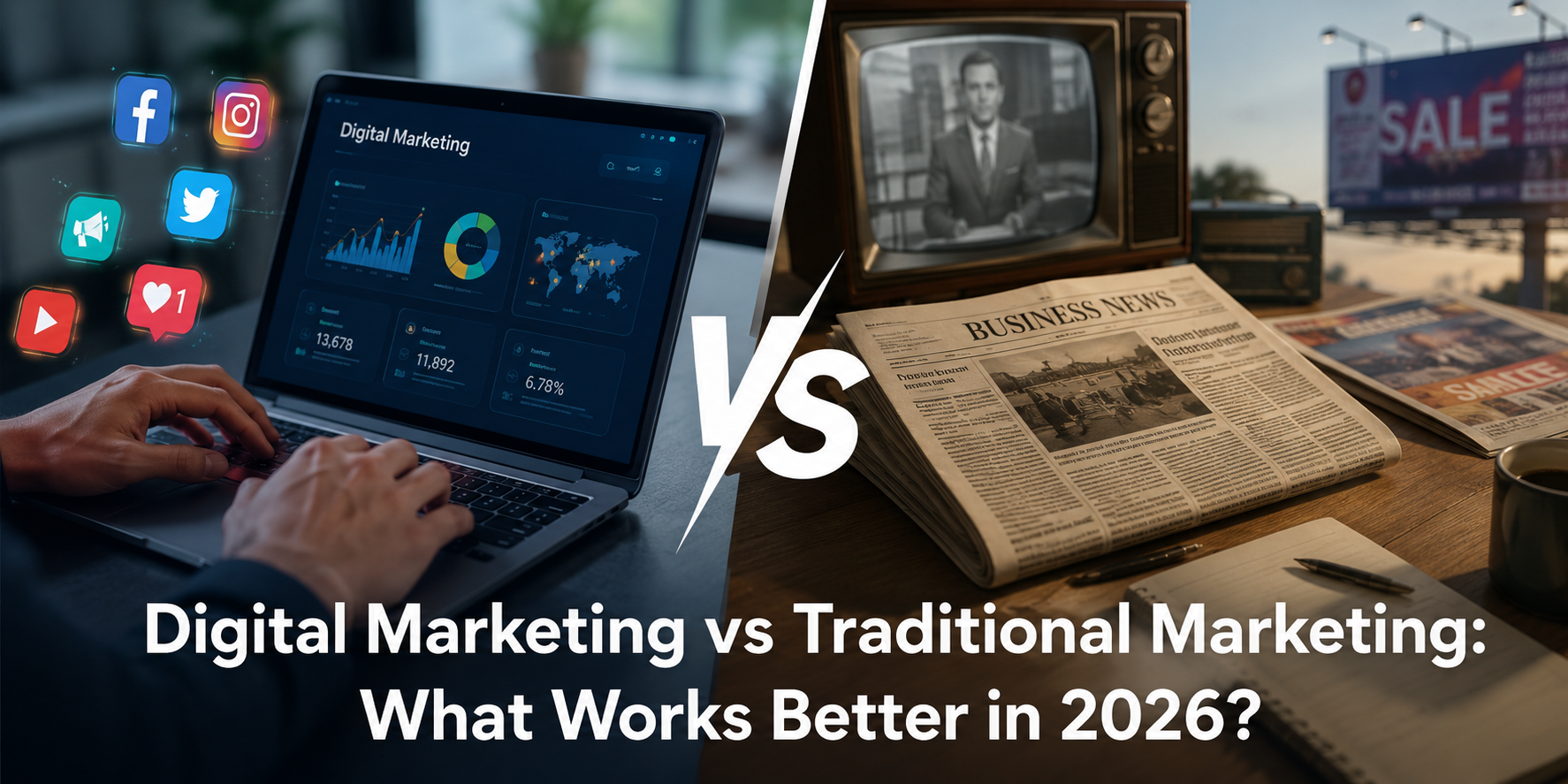
In 2026, the marketing environment has become a hyper-connected ecosystem that is powered by AI. The digital marketing vs traditional marketing is an age-old debate. It has changed the digital and traditional marketing together and as to how they integrate.
It is true that the world of the internet has never been as immersive as it is now. The physical presence is not deprived of a certain psychological importance.
At OCPbiz, we feel that it is these shifts that can lead to business permanence.
Being a local startup or a global business, the choice of the right medium determines your growth pattern. We know it is achievable because it helps to bridge the gap between strategy and implementation and innovative strategy.
Key Difference Between Digital and Traditional Marketing
The traditional and digital marketing are closer than ever in 2026. Yet, the key difference between digital and traditional marketing lies in functionalities of the two.
Yes, they are still different. These are the main differences that you should take into account:
Engagement Style
Digital: Provides a two-way conversation. Brands converse with their customers through online marketing strategies using AI chatbots or real people.
Traditional: Even now, to a great extent, is a unidirectional broadcasting. They offer offline advertising methods that were used before this digital rush.
Targeting Precision
Digital: Employs predictive analytics and first-party data to target individuals.
Traditional: Is geographic and demographic by nature. You get to a crowd as opposed to an individual.
Flexibility and Speed
Digital: It is possible to launch campaigns, pause them, or turn them around within seconds.
Traditional: Message is fixed once a printed magazine is done or a billboard is put up.
Cost Comparison
Entry Barriers
Digital: Still has the least barrier to entry. Social media ad campaign can be initiated with as low as $5 a day.
Traditional: These still bear high initial expenses.
Sustainability of Costs
Digital: Entry is cheap, but remaining in the game is increasingly becoming costly.
Traditional: Some traditional media have become less expensive for local domination.
Hidden Expenses
Digital: Continuous production of content, community, and software subscription.
Traditional: Costs are typically one-time campaign cycle.
ROI Analysis
Long Run Versus Short Run Gains
Digital: Superb to make instant conversions and Flash Sales.
Traditional: Establishes brand equity and credibility.
Attribution Clarity
Digital: Provides the closest to attribution.
Traditional: ROI can be determined by using brand lift studies.
Which One Is the Best to Use?
In 2026, the answer is hardly ever to be one or the other. Data-driven marketing wins.
Brands that are most successful employ a hybrid strategy.
Select Digital Marketing When:
- You are seeking hot leads and sales.
- The audience you are targeting is Gen Z or Gen Alpha.
- Your budget is minimal and flexible.
- You should collect in-depth information about consumer behavior.
- Digital marketing offers a competitive advantage.
Use Traditional Marketing When:
- You are creating a luxury brand.
- You are addressing a local community.
- You need mass awareness in limited time.
Winning Formula: The OCPbiz Way 2026
The consumer in the present world is in a Phygital world.
They will see an advertisement on a bus stop, scan a code and visit your website, and later get retargeted with a digital advertisement.
To be a winner in 2026, your brand message should remain consistent across all touchpoints.
With OCPbiz, businesses can utilize advanced digital technologies while maintaining the impact of traditional outreach.
Thought Final
Avoid picking a side, pick a strategy.
Going digital, traditional, or both ways, make sure that your data drives your decisions.
Ready to scale? Call us at +91 9558810195 or write to us at info@ocpbiz.com



 4 min read mins read
  0 Comments