
 November 23, 2026
 8 min read mins read
 0 Comments
Every successful business depends on effective planning, financial stability, and well-organized daily operations. Whether launching a startup or managing an established company, business operations management plays a crucial role in improving productivity, controlling costs, and achieving sustainable growth.
With advancements in artificial intelligence (AI), cloud computing, automation, and digital financial systems, businesses have new opportunities to streamline operations and improve decision-making. For entrepreneurs establishing businesses in the United States, efficient operations management also involves company registration, accounting, payroll, banking, and regulatory compliance. Understanding these processes helps companies build a strong operational foundation while preparing for future expansion.
Business operations management refers to the planning, coordination, monitoring, and improvement of activities necessary to operate a business efficiently. It focuses on managing employees, financial resources, technology, business processes, and assets to achieve organizational objectives. Business operations ultimately aim to generate value from resources.
For example, a physical asset such as a commercial building may generate rental income. An intangible asset such as intellectual property may generate revenue through licensing or royalties.
The activities involved in generating, increasing, and protecting this value form an important part of the business operations cycle. Modern operational management combines traditional business principles with digital technology, performance monitoring, and strategic planning.
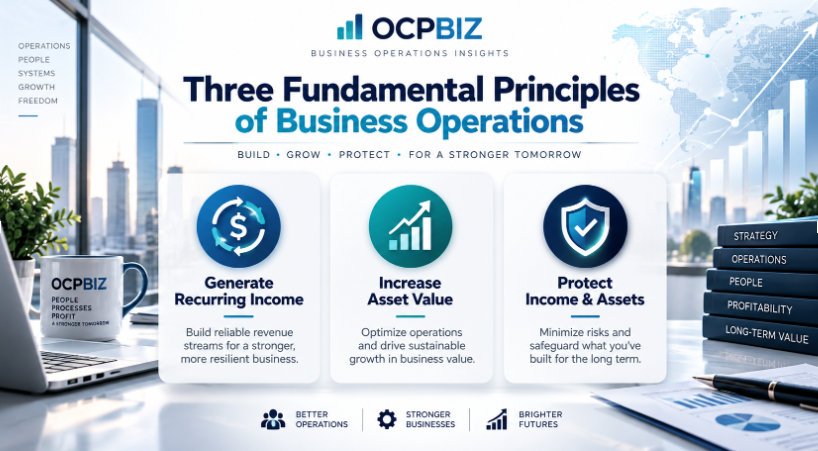
Effective business operations management revolves around three essential principles.
Recurring income supports financial stability and makes business planning more predictable.Companies can generate recurring revenue through subscriptions, service agreements, repeat customers, licensing arrangements, and long-term contracts. Improving customer retention, maintaining service quality, and building lasting business relationships can strengthen revenue consistency.
Business assets include property, equipment, inventory, intellectual property, technology, customer relationships, and brand reputation. Organizations can increase asset value by improving productivity, investing in employee capabilities, adopting suitable technology, and optimizing resource utilization.
For example, implementing efficient digital workflows may allow employees to handle additional customers without significantly increasing administrative expenses.
Businesses must protect their income, resources, customer information, and intellectual property against financial and operational risks. Important measures include accurate financial reporting, cybersecurity, insurance, contract management, internal controls, and regulatory compliance.
Together, these three principles provide the foundation for sustainable business growth.
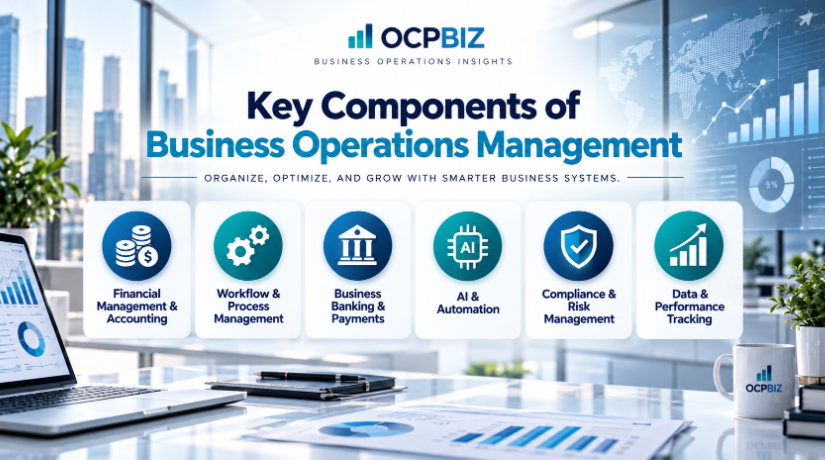
Several interconnected functions contribute to efficient business operations.
Financial management ensures that businesses maintain control over revenue, expenses, profitability, and cash flow. Essential activities include bookkeeping, budgeting, invoice management, payroll processing, financial reporting, and expense monitoring. Accurate records support better financial decisions while helping businesses prepare for relevant tax and reporting obligations.
Cloud accounting platforms can simplify transaction monitoring and provide timely access to financial information. Professional accounting and payroll services can also help businesses organize financial administration and maintain consistent records.
Business processes define how organizations complete recurring activities such as customer onboarding, order processing, payments, and service delivery. Poorly managed workflows can create delays, duplicated work, and unnecessary expenses. Businesses can improve efficiency by documenting Standard Operating Procedures (SOPs), assigning responsibilities, and monitoring operational performance. Clear workflows also make employee training and business expansion more manageable.
Organized banking and payment systems are essential for maintaining financial visibility. A dedicated business bank account helps separate company and personal finances, supports recordkeeping, and simplifies payment reconciliation. Businesses should also establish reliable procedures for receiving customer payments, paying suppliers, and monitoring cash flow. For international entrepreneurs, US business banking assistance may be helpful when navigating documentation requirements and banking eligibility.
Technology is changing how businesses manage financial, administrative, and customer-facing activities. Artificial intelligence, automation, and cloud-based software can improve efficiency when implemented carefully.
AI-powered tools can help organizations analyze information, process documents, support customers, and generate operational insights.
Common applications include:
Businesses should maintain human oversight and establish suitable privacy and cybersecurity safeguards when implementing AI.
Business process automation reduces repetitive administrative activities through predefined digital workflows.
For example, organizations can automate invoice reminders, appointment confirmations, document approvals, customer onboarding notifications, and recurring reports. Automation can reduce manual workload and improve consistency.
However, companies should simplify and standardize processes before automating them.
Cloud platforms allow authorized employees to manage information and collaborate across different locations. Businesses commonly use platforms such as QuickBooks and Xero for accounting, HubSpot for customer relationship management, and Asana for project coordination.
Choosing appropriate software depends on organizational requirements, available budgets, security expectations, and integration capabilities.
Technology should solve genuine operational challenges rather than introduce unnecessary complexity.
Operational efficiency means achieving business objectives while using available resources effectively. Companies can improve performance through several practical strategies.
Review everyday activities and identify tasks that require excessive time, resources, or manual intervention. Look for duplicated efforts, unclear responsibilities, and avoidable administrative costs.
Document important workflows so employees understand their responsibilities. SOPs promote consistency, improve accountability, and reduce operational errors.
KPIs help businesses evaluate performance and identify opportunities for improvement. Useful indicators include operating expenses, profitability, customer retention, invoice collection periods, and employee productivity.
Introduce accounting software, customer management systems, automation platforms, and reporting dashboards where they deliver measurable benefits.
Protect business information through multi-factor authentication, secure backups, access controls, software updates, and employee awareness training.
Review operational performance regularly and update processes when business requirements, technologies, or market conditions change.
Startups often operate with limited financial resources and small teams. Establishing organized business systems early can help avoid administrative complications as the company grows.
Important operational considerations include:
Entrepreneurs planning to establish a US business should carefully evaluate their formation and ongoing operational requirements.
Professional company incorporation services can assist entrepreneurs with important steps in establishing their business.
Regulatory compliance is an essential part of protecting business value. US businesses may have federal, state, and local obligations involving taxation, employment, registrations, licensing, and reporting. Requirements vary depending on business structure, activities, ownership, and location.
Importantly, under FinCEN’s August 2026 final rule, US-created entities are exempt from federal Beneficial Ownership Information reporting, while certain foreign-formed entities registered to do business in the United States may remain subject to reporting requirements. Businesses should verify their current obligations rather than relying on outdated compliance information.
Maintaining organized records, reviewing deadlines, and obtaining appropriate professional guidance can help companies manage compliance risks.
International entrepreneurs establishing US businesses may face additional administrative and operational considerations.
These can include company structure selection, federal and state registration requirements, tax identification, banking eligibility, bookkeeping, and ongoing compliance.
Having clear operational processes and access to appropriate professional assistance can simplify the administration of a US company.
Businesses should also understand that forming a company and obtaining banking services do not automatically resolve every tax, licensing, or regulatory obligation.
Managing business operations requires coordination between financial administration, company formation, and compliance activities.
OCPBIZ supports entrepreneurs and businesses through services that include US company incorporation, business startup assistance, banking support, accounting, payroll, tax-related services, and regulatory compliance assistance.
By helping organize essential administrative functions, OCPBIZ enables entrepreneurs to focus more attention on customers, business development, and strategic growth.
Whether establishing a new business or managing an existing company, professional operational support can help create a more organized business foundation.
Effective business operations management combines financial planning, efficient processes, technology, and regulatory compliance to create lasting business value.
By adopting AI, automation, and cloud-based solutions, companies can improve operational efficiency while protecting their assets and supporting growth.
For entrepreneurs establishing or managing US businesses, OCPBIZ offers professional support with business formation, financial administration, and compliance needs.

Thank you for your message. It has been sent successfully.