
 July 23, 2026
 7 min read mins read
  0 Comments
 Starting a business in the United States while you’re overseas can feel like a great idea, yet it also drags along a very tricky set of paperwork and rules. For most foreign founders one of the big early moves is getting an Employer Identification Number, usually called an EIN.
This guide by OCPbiz is meant to help you understand who qualifies, how the ein number for non residents request work when you are applying from India or other countries. It will also show you about how to deal with the irs ein application when it gets awkward or confusing.
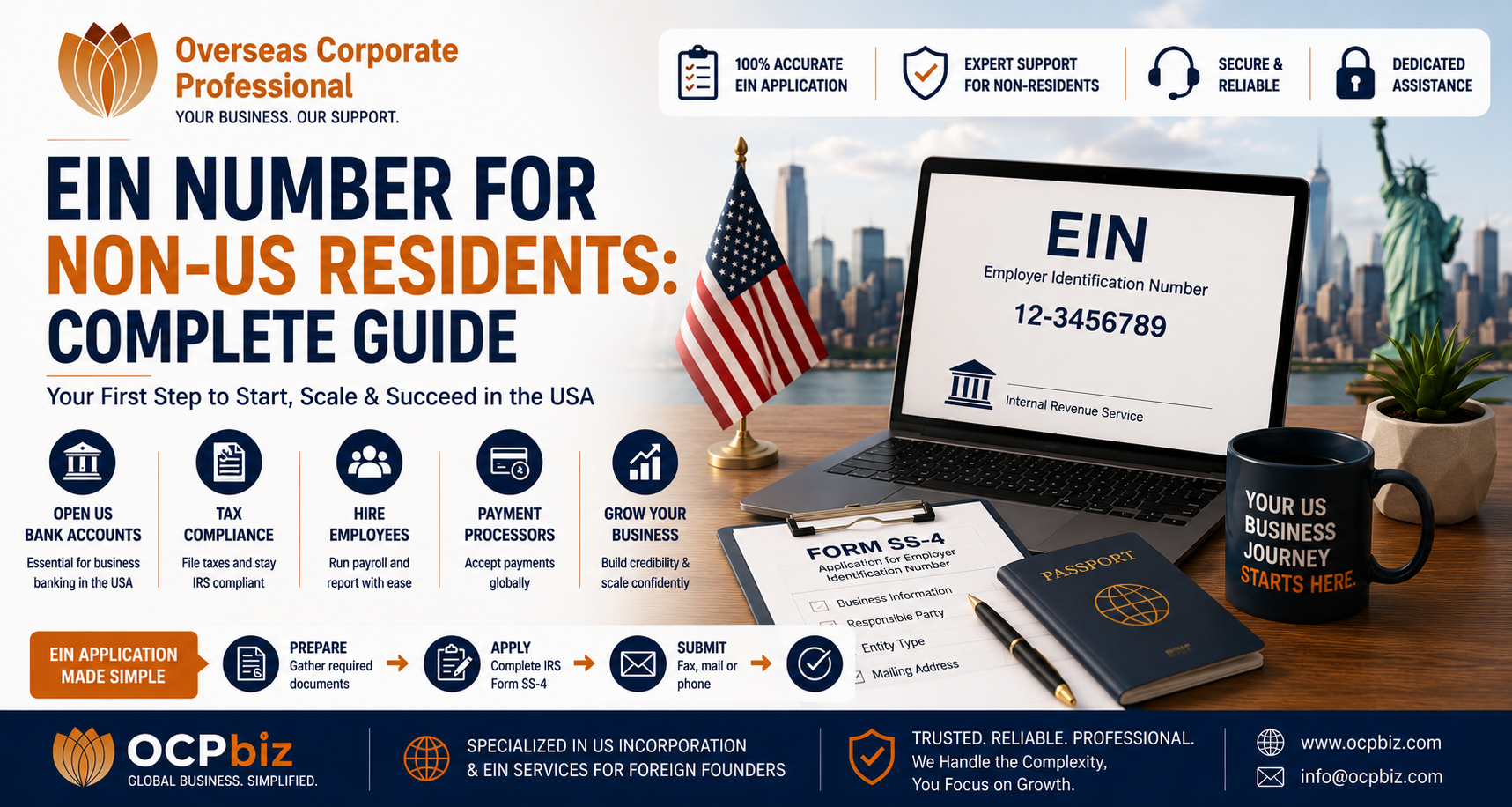
An Employer Identification Number, EIN, is a nine-digit number the Internal Revenue Service, IRS, assigns to business entities that need it to handle taxes within the US. The ein number for non residents is no exception.
Getting an ein for llc, for a corporation, or for any related arrangement isn’t optional, if you want things to run smoothly.
Now, the question may arise as to how to get ein number? You may qualify whether you are a solo operator or part of a larger organization. In general, irs ein application is for those who own or control a US based entity, such as:
To make sure your application is successful, try to keep everything organized, so its not all over the place later:
Since non-US residents usually don’t have an SSN or ITIN, they generally cannot use the IRS online portal. In that case you will need to use ein application services that work for international owners, or do a manual submission via Form SS-4.
Step-by-step process:
Form SS-4 is basically the core of the whole application. For non-residents, Part II is usually the most important part, because thats where you choose the entity type and define it.
Common mistakes include transposing digits, using the wrong version of the form, or providing a business address that doesn’t match the rest of your info. Those kinds of problems can cause rejection pretty quickly. Also, make sure the “Responsible Party” is exactly the same name as on your government identification.
The timeline depends on how you submit it and it may approximately take about:
| Submission Method | Estimated Processing Time |
|---|---|
| Fax | 7–10 Business Days |
| 4–8 Weeks | |
| Telephone | Immediate (but only, for qualified candidates) |
Note: International delays sometimes show up because of an IRS backlog, or because some information is missing from the SS-4.
Trying to get through government paperwork can feel like trying to learn some foreign language on the fly. If you are working with the IRS, you have probably stumbled into three common acronyms: SSN, ITIN, and EIN.
Even though they all look like they’re just number strings for identifying taxpayers or entities, in reality they do pretty different jobs. Mix them up and you might end up with annoying processing delays, tax penalties, or forms that just get rejected, not because you “did everything wrong” but because the identifier doesn’t match what the IRS expects.
Here’s a straightforward guide that explains what each one is, who actually needs it, and the key ways they differ.
Honestly the simplest way is to focus on the main use. Use this table when you’re filling tax or business documents, just to keep it all from blurring together.
| Feature | SSN (Social Security Number) | ITIN (Individual Taxpayer Identification Number) | EIN (Employer Identification Number) |
|---|---|---|---|
| What is it? | A unique 9-digit personal identifier. | A 9-digit tax processing number. | A 9-digit business tax ID (like an SSN for a company). |
| Who is it for? | It is for US citizens as well as for permanent residents | Foreign nationals are not eligible for an SSN. | Businesses, LLCs, and corporations. |
| Main Purpose | Social Security benefits & taxes. | Filing annual US tax returns. | Business taxes, payroll, and banking. |
| Issued by | Social Security Administration (SSA). | Internal Revenue Service (IRS). | Internal Revenue Service (IRS). |
Yes, you can, though you will still want a dependable mailing address. A lot of non-residents use the address of their us incorporation services provider, or a Registered Agent. That way you get IRS tax documents in time, instead of waiting too long or missing them.
Getting your EIN is basically the “green light” that starts the whole US market process. The paperwork, mainly Form SS-4, can feel heavy for non-residents, but the payoff is real. You gain tax compliance credibility, easier banking access, and better chances for professional scale. Just avoid the usual traps by keeping your documentation accurate and making sure your business structure is set up properly.
Need some help sorting out all those IRS application bits? Don’t just leave your registration to luck. Stop by OCPbiz for real, expert, kind of practical support on US incorporation services, EIN help and even more. We stay locked in on helping foreign founders like you start and scale with real confidence.
Get started with OCPbiz today – Expert EIN Support for Non-Residents!
Disclaimer: This is for educational purposes only. If you are unsure about your tax situation or what you are required to do legally, talk with OCPbiz or a qualified CPA or tax attorney.
Yes, the IRS doesn’t charge anything to issue an EIN. Nonetheless, a third-party company registration usa service might charge a fee for some admin assistance, or the paperwork handling in general.
Technically yes, but you will hit serious constraints with banking, tax filing workflows and payment processors.
No, non-residents can apply without one.
Yes, the process is designed to be able to deal with foreign founder EIN requests worldwide. In fact, foreign founder ein are very common and you can even apply for ein from india!

Thank you for your message. It has been sent successfully.